


Edited byStaff Writers
The cost of airfares has risen by around half the rate of inflation over the last five years, and at just a fraction of the proportion of several essential daily items, data from Flight Centre Corporate shows.
According to the Reserve Bank of Australia, a basket of goods and services valued at $1 in calendar year 2019 would cost $1.20 in calendar year 2024, reflecting a 20 per cent increase in goods and services, based on an annual inflation rate of 3.8 per cent.
FCM Consulting, Flight Centre Corporate’s business travel consulting arm, has found that while the cost of living was on the rise, the cost of travel was moving at well below the rate of inflation over five years since the pandemic.
“We’ve seen a gradual softening of domestic fares over the last 12 months, with a 12 per cent decline in the cost of an economy seat at the beginning of 2025 compared to early 2024. That has resulted in a relatively low five-year increase, despite the pretty sizable uplift we saw in the few years during and post-COVID,” FCM Consulting Director APAC Felicity Burke said.
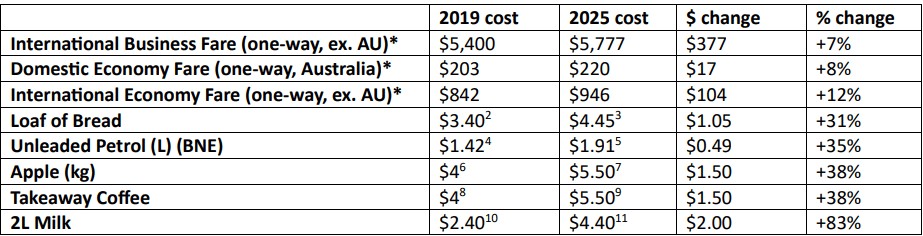
“International business class tickets have fared the best over the past five years, with an overall increase of seven per cent, while domestic economy fares followed at a growth of eight per cent, and international economy fares rose by 12 per cent since 2019.”
According to reported pricing, a 2-litre carton of milk (+83 per cent), take away coffee (+38 per cent), 1kg bag of apples (+38 per cent), unleaded petrol (+35 per cent), and a loaf of bread (+31 per cent), rose at a far higher rate than the cost of both domestic (+8 per cent) and international (+7-12 per cent) airfares between 2019 and 2025.
“When you compare the increase in the cost of travel against the rise we’ve seen for fuel, milk, bread, even a bag of apples, it really puts things into perspective,” Burke said.
“This comes while the cost of jet fuel increased by 25 per cent in 2024, compared to 2019, according to IATA, but that does appear to be easing back towards 2019 levels in early 2025.
“Passenger numbers have lifted year on year, and domestic capacity levels still lag behind what they were pre-COVID, which reflects the growing operating costs and volume of demand airlines have experienced during this period.”
Fares predicted to remain steady
Burke said travellers could expect airfares to plateau for the short-to-medium term, with fares predicted to remain steady.
“What we can expect to see moving forward throughout the rest of the year is a balancing in the cost of fares – we don’t expect to see any significant increases outside of those seasonal variations that will come around holidays and major events. But don’t expect to see any significant or long-lasting drops in the price of flying domestically or internationally either,” she said.
“However, international flights will commence from next month (June 2025) off the back of the Virgin Australia and Qatar partnership, and they may move to stimulate demand by offering short-term bargains.
“Some predictability is good for travellers, who will be able to better plan and budget as we come out of a period of fairly high-end travel costs.
“The advice is to get in early – the sooner you can book the fare, the better, particularly if you’re travelling in those peak seasons. If you have end-of-year international travel plans, I would be booking those in now. Where demand is high for airlines, the occupied seat capacity is going to be high, so the closer you are to the date of travel, the higher the cost of the fare.
“Corporate travellers have limited ability to be flexible about when and where they travel, but awareness is key for budgeting. Understand which holidays and major events might be occurring that could have an impact on the cost of travel, beyond just airfares, and plan how you can balance critical travel in peak seasons, with more flexible travel in off seasons.”
Burke said a strong and competitive airline industry was good for everyone, and some positive steps were taken in international airline capacity growth in recent months was good for travellers.
“Domestic capacity has struggled to keep pace with the rate of demand on local routes over the past 12-18 months.
“International inbound capacity has been a better story – we’ve seen a lot of international carriers investing in this market over the last couple of years and recognising that Australians are big travellers – be that for work or play, or a combination of both.”
Source: Travelweekly.com




More Stories
Mexico flights resume after surge in violence sees thousands of tourists stranded
Kenya Airways cancels New York flights, announces new flight dates
Pilot praised after crash-landing faulty Somali passenger plane on seashore