


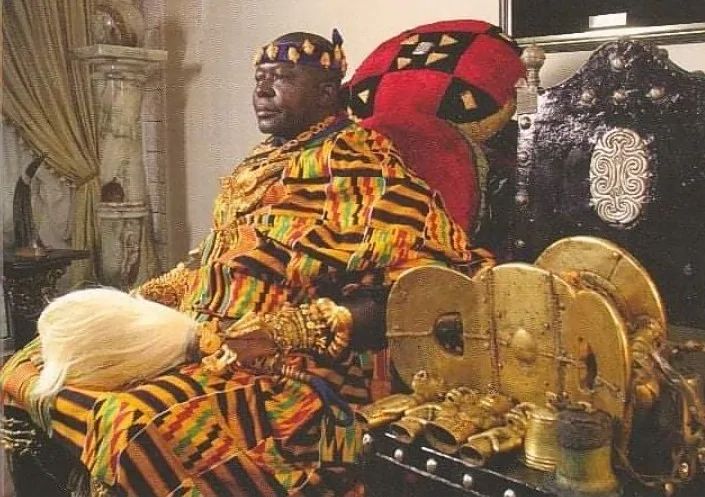
The reigning Asante King Otumfuo Nana Osei Tutu ll; on his left is the Golden Stool
The Golden Stool (Ashanti -Twi (full title): Sika Dwa Kofi “the Golden Stool born on a Friday”) is the royal and divine throne of kings of the Asante people and the ultimate symbol of power in the kingdom.
According to legend, Okomfo Anokye, High Priest and one of the two chief founders of the Asante Confederacy, caused the stool to descend from the sky and land on the lap of the first Asante king, Osei Tutu. Such seats were traditionally symbolic of a chieftain’s leadership, but the Golden Stool is believed to house the spirit of the Asante nation – living, dead, and yet to be born.
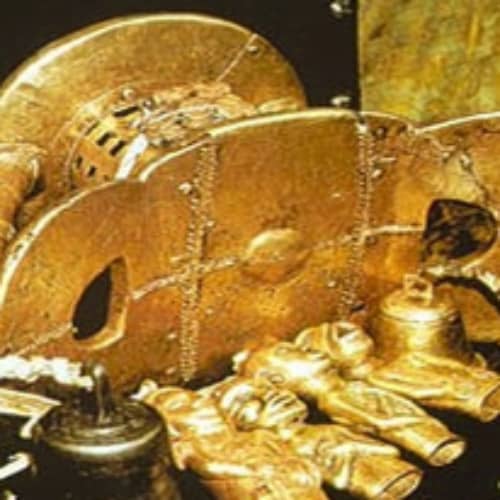
The Golden Stool
Appearance and craftsmanship
The Golden Stool is a curved seat, 46 cm high, with a platform 61 cm wide and 30 cm deep. Its entire surface is inlaid with gold, and hung with bells to warn the king of impending danger.
It has not been seen by many and only the king, queen, and trusted advisers know the hiding place. Replicas have been produced for the chiefs and, at their funerals, they are ceremonially blackened with animal blood, a symbol of their power for generations. The stool is one of the main focal points of the Asante today because it still shows succession and power.
Symbology and ritual
Each stool is understood to be the seat of the owner’s soul and, when not in use, it is placed against a wall so that other souls passing by may relax on it.
The Golden Stool is the royal throne and must never touch the ground; that is why it is always placed on a blanket. That is why the Golden Stool is carried to the king on a pillow, as only the Asantehene himself is allowed to handle it.
During inauguration, the new king is raised up and lowered over the stool without touching it. On solemn occasions, the Golden Stool is placed on the king’s left side on a throne of its own, facing the crowd.
Historical conflict
Many wars have broken out over the ownership of the royal throne, and its sacredness.
In 1896, Asantehene Prempeh I was deported rather than risk losing both the war and the throne. In 1900, Sir Frederick Hodgson, the Governor of the Gold Coast, demanded to be allowed to sit on the Golden Stool, and ordered that a search for it be conducted. This provoked an armed rebellion known as the War of the Golden Stool, which resulted in the annexation of Ashanti to the British Empire, but preserved the sanctity of the Golden Stool.
In 1921, African road workers discovered the stool and stripped some of the gold ornaments. They were taken into protective custody by the British, before being tried according to local custom. They were sentenced to death, but the British intervened and the group was banished instead. An assurance of non-interference with the stool was then given by the British and it was brought out of hiding.
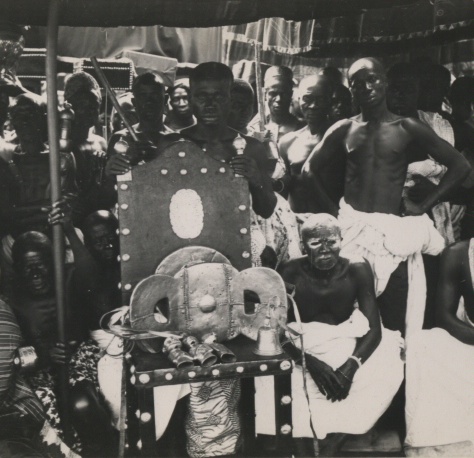
The Golden Stool on its throne, the hwedom dwa (1935)
While the Golden Stool is made of pure gold, replicas are often made from wood. Each stool is made from a single block of the wood of Alstonia boonei (a tall forest tree with numinous associations) and carved with a crescent-shaped seat, flat base and complex support structure. Some designs contain animal shapes or images that recall the person who used it. The general shape of Asante stools has been copied by other cultures and sold worldwide.
Source (edited): Wikipedia




More Stories
Women at the Helm: Driving Evolution and Inclusion in Business Travel
Searching for the ‘angel’ who held me on Westminster Bridge
The full story of Thailand’s extraordinary cave rescue