


Story by Lee Jeong-gu, Cho Jaehyun
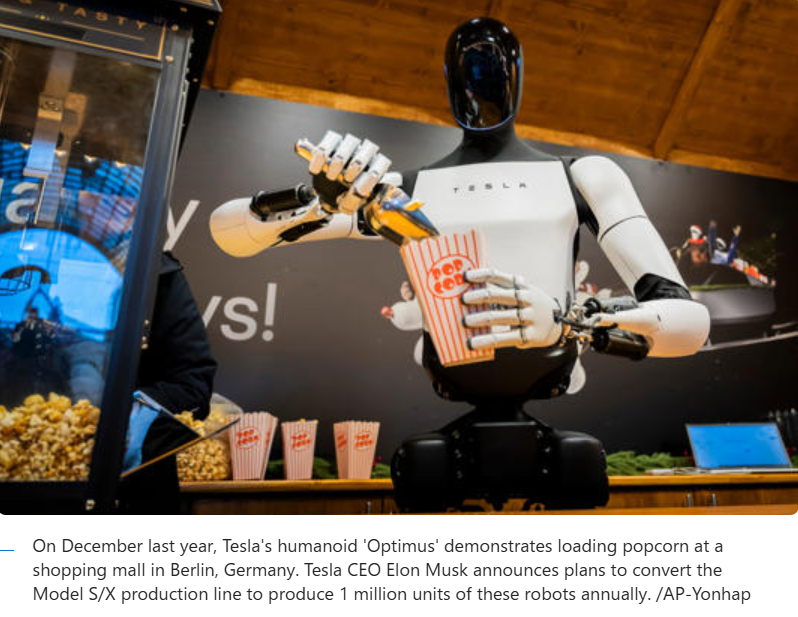
On December last year, Tesla’s humanoid ‘Optimus’ demonstrates loading popcorn at a shopping mall in Berlin, Germany. Tesla CEO Elon Musk announces plans to convert the Model S/X production line to produce 1 million units of these robots annually. /AP-Yonhap
Tesla, the U.S. company, has chosen humanoid robots as a breakthrough against its first-ever revenue decline in 23 years since its founding. CEO Elon Musk declared, “We will convert the Fremont electric vehicle factory in California, U.S. into a robot factory to produce 1 million humanoid robots ‘Optimus’ annually.” U.S. media outlets have called this “the boldest yet riskiest strategy in Tesla’s history.”
On the 28th (local time), Tesla announced that its automotive sales last year decreased by 10% compared to the previous year to $69.5 billion, with total revenue dropping by 3% to $94.8 billion. This marks the first annual revenue decline since the company’s founding in 2003. What was surprising was Musk’s solution. During the earnings call, he officially announced the discontinuation, stating, “It is time to honorably conclude the Model S and X.” These two models, launched in 2012 and 2015 respectively, were iconic in establishing Tesla’s premium image. However, as sales plummeted due to the onslaught of mid- to low-priced electric vehicles, the company made the bold decision to withdraw from them.
Instead, Musk stated, “We will replace the Model S and X production lines at the Fremont factory with lines capable of producing 1 million Optimus robots annually.” Following this decision, the Fremont factory, a symbolic site where the first Model S was delivered in 2012, will transform into a production base for 1 million Optimus robots.
Graphics by Yang In-sung
◇Hyundai Motor and Tesla, Automakers Competing with ‘Robots’
U.S. media outlets have offered mixed reviews of Musk’s decision, calling it “a choice to bet both Tesla’s oldest factory and proven revenue sources on a humanoid robot that has yet to be commercialized” and “the market will be divided between viewing Tesla as a struggling automaker and the world’s top robotics company.”
Last year, Musk emphasized a robot-centric future vision amid slowing electric vehicle sales, stating, “80% of Tesla’s corporate value will come from Optimus in the future.” This time, Tesla has gone a step further, announcing an overwhelming volume offensive. It explained that the next-generation Optimus (3rd generation), set to launch in the first quarter of this year, is “a design model for mass production of 1 million units.”
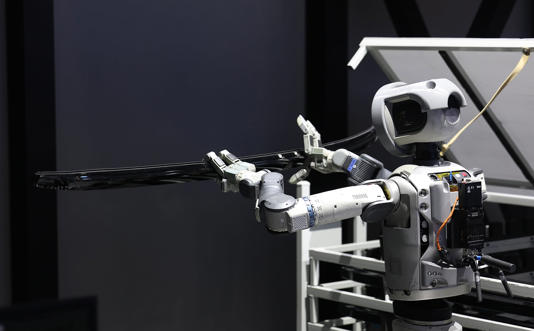
At the US Las Vegas Convention Center, where CES 2026 is held on the 7th, the humanoid robot ‘Atlas’ demonstrates moving parts. Hyundai Motor Group plans to establish a system to mass-produce 30,000 Atlas units annually by 2028 and deploy them at Hyundai Motor Group Metaplant America (HMGMA), its US factory. /Yonhap
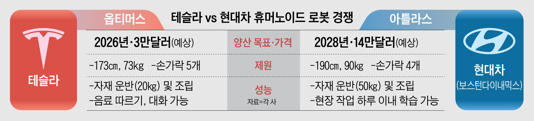
In contrast, Hyundai Motor Group, which first unveiled its humanoid ‘Atlas’ at CES 2026 earlier this year, has presented a relatively cautious roadmap. Hyundai aims to deploy Atlas at its U.S. electric vehicle factory starting in 2028, targeting annual production of 30,000 units. Hyundai’s Atlas, designed for industrial use in factories and logistics, is expected to cost around $140,000. Tesla’s Optimus, however, aims to be a general-purpose AI robot for both home and service sectors, with a target price of around $30,000.
◇Mass Production and Profitability Challenges… Anticipation for a ‘ChatGPT Moment in Robotics’
The key to entering the humanoid robot era boils down to three factors: a mass production system to lower costs, securing profitability, and resolving conflicts in industrial settings.
Technologically, Chinese company Unitree ignited the mass production race by shipping 5,500 humanoid robots last year. Unitree CEO Wang Xingsheng predicted explosive growth, stating, “The current robot industry is similar to the 1-3 years before ChatGPT’s release.” Musk also remarked, “The production speed of Optimus will eventually become insanely fast,” adding, “It will start slow but accelerate rapidly once it reaches a certain trajectory.”
In contrast, in Korean society, the introduction of humanoid robots has begun to emerge as a core issue in labor-management conflicts. The Hyundai Motor labor union recently declared a “robot rejection,” stating, “Not a single robot can be deployed without labor-management agreement.” Regarding this, President Lee Jae Myung mentioned the Hyundai Motor union case during a senior secretariat meeting at Cheong Wa Dae on the 29th, saying, “One cannot avoid the massive cartwheel of robot deployment. Society must adapt quickly.” The debate over humanoid robot adoption is expanding beyond industry to become a social issue.
More Stories
Ghana: 59 fishermen rescued in armed raid by ‘Black Boat’ pirates – Awutu Senya West MP confirms
Ghana: ‘Factories operating at scale’: Mahama targets energy reform for industrial growth
Ghana: Cement firms warn of price hikes as clinker ships stall at port